 Annie
AnnieAt a Glance
- Ich (also spelled ick, and known in the hobby as white spot disease) is a common parasitic infection in betta fish that usually causes small white spots, flashing, clamped fins, lethargy, and sometimes rapid breathing.
- Most cases are treated either with a formalin-based ich medication at normal betta temperature or with a non-formalin protocol using heat and aquarium salt.
- Treatment needs to continue even after the spots begin to disappear, because the visible white spots are not the stage that treatment kills.
If your betta suddenly has tiny white dots that look like grains of salt, ich is one of the most likely causes. Ich is a common freshwater fish parasite, and in bettas it often causes white spots, flashing, clamped fins, lethargy, and loss of appetite.
The good news is that ich is usually treatable if you catch it early and continue treatment long enough to break the parasite’s life cycle.
What Does Ich Look Like on a Betta Fish?
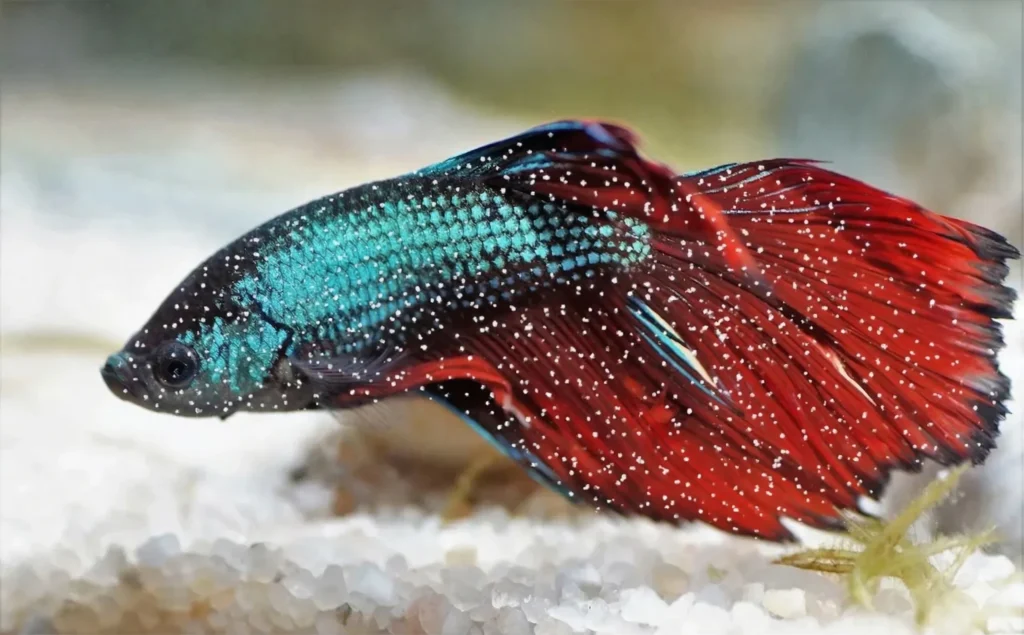
The most recognizable sign of ich is a scattering of small white spots on your betta’s body, head, or fins.2 These spots are often described as looking like grains of salt because they are usually round, distinct, and slightly raised. Each visible spot is a parasite cyst embedded in the fish’s skin.
Other common signs of betta ich include:
- Flashing, or rubbing against plants, decorations, or the substrate
- Clamped fins
- Lethargy
- Loss of appetite
In mild cases, the spots may show up only on the fins or in one small area. In more severe infections, the gills can be affected even when the skin does not look heavily spotted, which may cause rapid or labored breathing.5
How to Treat Ich in Betta Fish
The goal of ich treatment is to kill the parasite during its free-swimming stage, not while it is visible as white spots on the fish. That means treatment has to continue long enough to catch newly hatched theronts over multiple life cycles.
For most betta keepers, the simplest treatment path is an over-the-counter formalin-based ich medication used at normal betta temperatures. Salt and heat can also be used in some situations, but they should be treated as alternative protocols rather than mixed casually with formalin-based products.
Step 1: Choose a treatment method
Option A: Use a formalin & malachite green-based ich medication
For most home aquariums, this is the most straightforward treatment option.
Two of the most widely available over-the-counter choices are:
- Ich-X (Hikari / Aquarium Solutions): a formalin and malachite green chloride medication commonly used for ich and other external protozoan infections.
- Rid-Ich Plus (Kordon): a formalin and malachite green chloride medication with a somewhat higher formalin concentration than Ich-X.
Both work by targeting the free-swimming stage of the parasite. Follow the label directions exactly for your tank size, and remove activated carbon before treatment because carbon can absorb the medication.
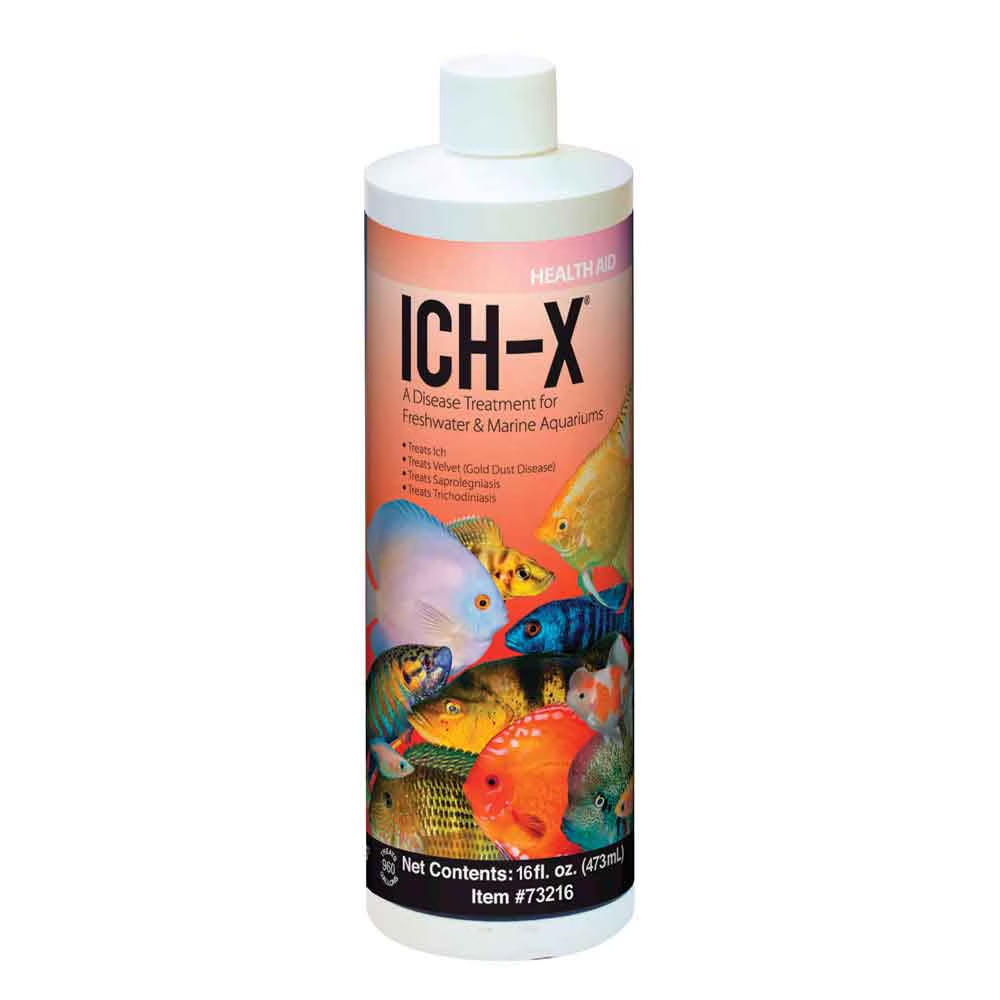
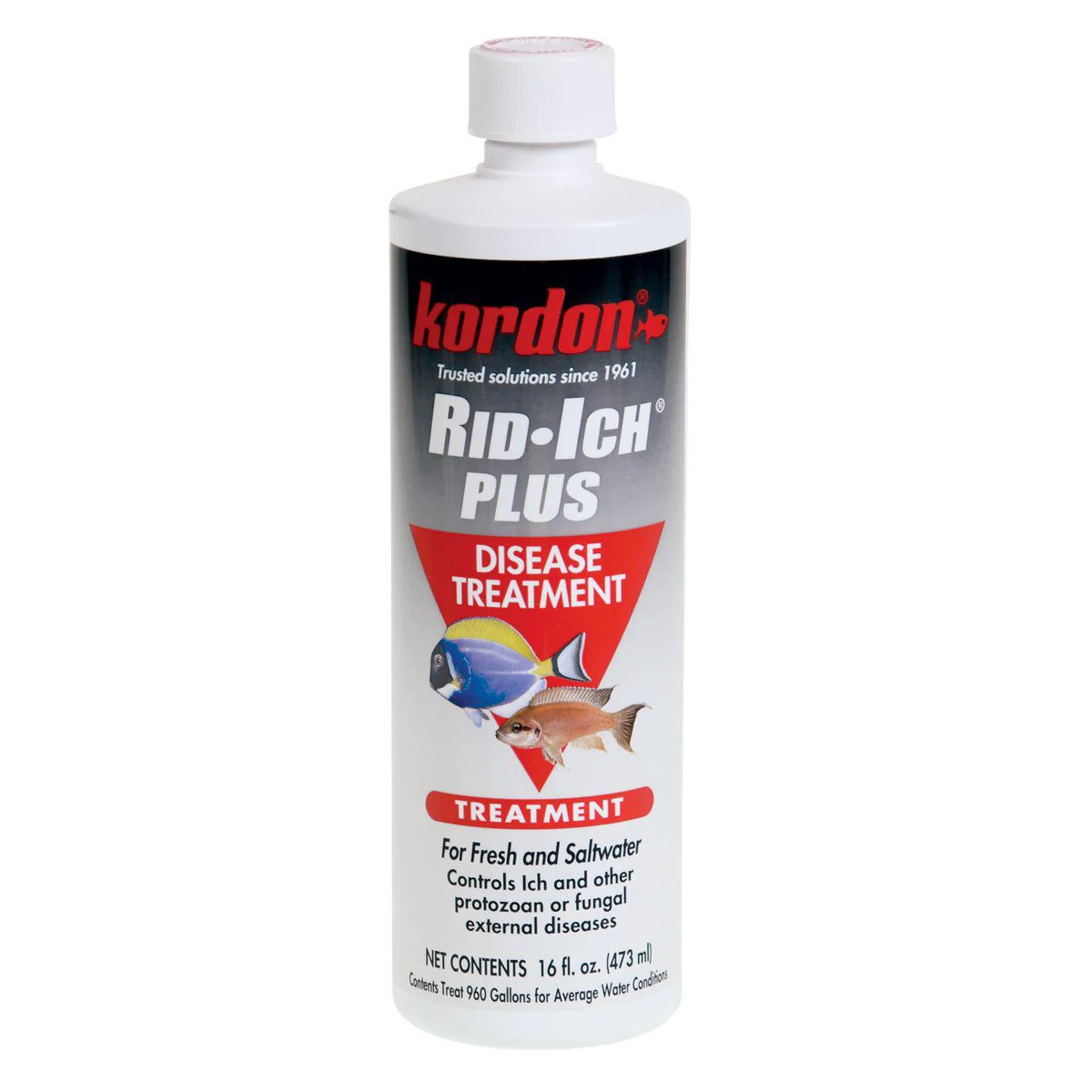
Important when using formalin-based medication: do not raise the temperature. Formalin becomes more toxic at higher temperatures. If you are using Ich-X, Rid-Ich Plus, or another formalin-based treatment, keep the tank in the normal betta range of about 78 to 80°F and let the medication do the work. You can, however, increase the tank salinity per the protocol listed below as a supportive measure.
Option B: Use heat with aquarium salt
If you are not using a formalin-based medication, heat combined with aquarium salt can be an alternative ich treatment. Heat helps by speeding up the parasite’s life cycle, while salt makes the water less tolerable for free-swimming theronts and may help reduce osmotic stress from skin damage.1
Raise the temperature gradually until the tank reaches about 30°C / 86°F. A reasonable pace is about 1 to 2°F per hour. Warmer water speeds up the parasite’s life cycle, which can help expose more free-swimming theronts during treatment.
At the same time, add aquarium salt according to your chosen protocol. A practical dosing range is about 1 to 1¼ tablespoons of aquarium salt per gallon of water (roughly 4 to 5 grams per liter).1 Dissolve the salt in a tank water before adding it. From personal experience, warming it up in the microwave helps the salt dissolve more completely. Just ensure you let the water cool back down before adding to the tank!
This method is not suitable for planted tanks, and you should make sure your betta, any tank mates, and any plants can tolerate the elevated temperature and salinity. Watch your fish closely for signs of stress. Once treatment is complete, lower the temperature gradually back to the normal range.
Important cautions before you treat
- Use extra care with malachite green. Many effective ich medications include malachite green. It can be effective, but the margin between therapeutic and harmful doses is relatively narrow in some species, so precise dosing matters. It is also photosensitive, so light reduction may be recommended during treatment. Follow the label exactly and monitor your betta closely.9
- Do not combine formalin-based medication with elevated temperature. If you choose Option A, keep the tank at normal betta temperature.
- Avoid potassium permanganate for ich. It can work against some external parasites, but ich usually requires repeated treatment, and repeated potassium permanganate use increases the risk of damage to the skin, gills, and eyes.1
Step 2: Keep treating after the white spots disappear
Do not stop treatment as soon as the spots fall off. The visible spots are not the stage that treatment kills. Once those parasites leave the fish, they reproduce in the tank and release new free-swimming theronts, which can re-infect your betta.
Keep treating according to the label or protocol long enough to kill newly hatched theronts over the next several days. At typical betta temperatures, the ich life cycle can complete in about 3 to 6 days, so stopping early often leads to the infection coming right back.1
Step 3: Change water and vacuum the gravel
Partial water changes during treatment help maintain water quality and may also remove some parasite cysts from the substrate before they hatch.1 Vacuum the substrate regularly and keep the tank as clean as possible throughout treatment.
After each water change, re-dose medication only if the label tells you to. If you are using aquarium salt, replace only the salt removed with the water change. For example, at 1 tablespoon per gallon, a 2-gallon water change means adding back 2 tablespoons of salt to the replacement water.
Remove any dead fish right away. Mature parasites can leave a dead fish quickly and continue reproducing in the tank if the fish is left in place.1 When disposing of old tank water or debris, avoid not dump it near another aquarium or water source to prevent further spread of the parasites.
What Causes Ich in Betta Fish?
Ich is common in aquariums, but it does not always cause disease.1 Outbreaks are more likely when your betta is stressed or weakened.
The most common triggers are:
- Temperature swings. Bettas depend on stable water temperature to stay healthy.6 A drop of even a few degrees from a heater failure, a cold water change, or a draft near the tank can stress the fish enough for ich to take hold.Fish are cold-blooded and depend on stable water temperature for immune function.2
- Poor water quality. Elevated ammonia, nitrite, or nitrate can all cause physiological stress and weaken your betta’s ability to fight off infection.2
- New fish or contaminated water. Adding a fish that carries ich, or pouring in water from a pet store bag, is a common way to introduce the parasite.7 Transport also stresses fish, which can make infection more likely.3
- General stress. Fish are more likely to get sick when they are already under stress.3 A new tank, a recent move, or an aggressive tankmate could all be contributing factors.
An ich outbreak isn’t a sign that you’ve failed as a betta keeper. It happens to careful, experienced people. What matters is how quickly you respond.
What Is Ich, Exactly?
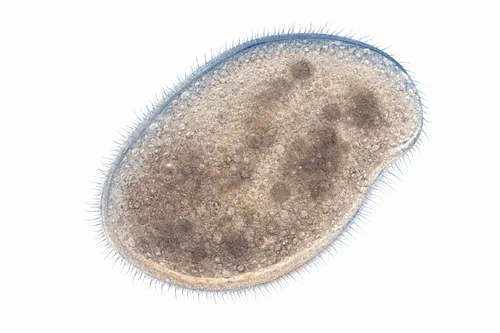
Ich (short for Ichthyophthirius multifiliis) is a single-celled parasitic protozoan that lives in virtually every freshwater aquarium.1 Most of the time it coexists with healthy fish without causing any problems. The trouble starts when a betta’s immune system gets compromised and the parasite gets a foothold.2
The organism has three life stages, and understanding them is what makes treatment make sense.
Stage 1: The Trophont
This is the stage you can see. The parasite burrows into your betta’s skin or gills and feeds on tissue while protected inside a cyst.3 This is the white spot, and it’s completely resistant to medication. Nothing you put in the water will touch it here.4
Stage 2: The Tomont
When the trophont matures, it drops off the fish and sinks to the substrate, where it encysts and divides rapidly. A single organism can multiply into hundreds of new parasites in one generation.1 The cyst also resists treatment.
Stage 3: The Theront
This is the infective, free-swimming stage, and the only stage medications can kill.4 Theronts hatch from the tomont cyst and have roughly 48 hours to find a host before they die.3 If they find your betta, the cycle starts over.
This is why treating ich takes multiple rounds over several days. You’re not treating the spots you see. You’re catching each new wave of theronts as they emerge.
Could It Be Something Else?
A few conditions can look similar at first glance.
Velvet (Piscinoodinium) usually looks like a fine gold or rust-colored dusting rather than distinct white spots. It can be difficult to see under normal lighting, but shining a flashlight across your betta at an angle can make the sheen much more obvious.2 Because velvet can cause many of the same behaviors as ich, such as flashing and lethargy, the color and texture of the coating are often the best clues.
Columnaris (Flavobacterium columnare) usually causes irregular white or gray patches rather than small, round dots.3 The patches may look fuzzy or cottony and often show up around the mouth, eyes, or along the back. If you are seeing uneven, fuzzy patches rather than salt-like spots, columnaris or fungus is more likely than ich.
If you’re not confident in what you’re seeing, a vet who works with fish can confirm a diagnosis.
After Treatment: What to Watch For
Keep watching your betta closely even after the white spots are gone. Continue treatment until you have seen no new spots and no further deaths for several days,1 and monitor your fish for at least a week after the last visible spot disappears.
Some fish that recover from ich may become asymptomatic carriers, meaning they show no obvious signs but can still pass the parasite to other fish.1
Watch for secondary infections too. The parasite can leave behind small wounds that give bacteria and fungi a way in.10 If you see frayed fins, cottony patches, or open sores after the ich clears, treat the secondary infection promptly.
How to Prevent Ich
You can’t guarantee your tank will never see ich, but you can significantly reduce the risk.
- Quarantine new fish. Any fish that may come into contact with your betta should spend time in a separate quarantine tank first.2 A quarantine period of two to four weeks gives many infections time to show up before the fish enters your main tank.
- Keep temperatures stable. A reliable heater and a thermometer you actually check are both essential. Temperature swings are one of the most common ich triggers.6
- Maintain water quality. Regular water changes, consistent testing, and a properly cycled tank help reduce stress and support your betta’s normal defenses.
- Do not share equipment between tanks without disinfecting it. Nets, siphons, and even wet hands can transfer parasites from one tank to another.