 Annie
Annie
If you’ve spent any time reading about betta care, you’ve probably seen the word “cycling” come up over and over. Maybe someone in a forum told you to cycle your tank before adding fish, or maybe you already have your betta and you’re wondering what you missed.
Either way, you’re in the right place. Cycling sounds technical, but it’s really just about making your tank safe for your betta to live in.
What Is the Nitrogen Cycle (and Why Should You Care)?
Every living fish produces waste. Your betta is constantly releasing ammonia into the water, mostly through their gills.² Uneaten food and decaying plant matter add to the ammonia load, too.
Here’s the problem: ammonia is toxic. Even a little can damage your betta’s gills, make it more likely to get sick, and cause other health problems.² In a perfect world, you’d get rid of all the ammonia right away. But in a closed glass box of water, you need some help to do that.
That help comes from bacteria.
The nitrogen cycle is just the name for a process where two groups of helpful bacteria break down fish waste:
- Ammonia → Nitrite. The first group of bacteria (including species like Nitrosomonas) colonizes your filter and converts toxic ammonia into nitrite.2
- Nitrite → Nitrate. A second group (including Nitrospira and Nitrobacter) takes that nitrite and converts it into nitrate.2
- Nitrate → Out of the tank. Nitrate is much less harmful than ammonia or nitrite, but it still builds up over time. You remove it with regular water changes.2 Live plants can absorb some nitrate too, but most home tanks don’t have enough plant mass to handle it all.1
When this cycle is running smoothly, your filter is essentially a living waste-processing system. Your betta produces ammonia, bacteria convert it through the chain, and you remove the slightly-less-toxic leftovers with water changes. That’s the whole thing.
What Happens in an Uncycled Tank
If you set up a new tank and add your fish right away, those helpful bacteria haven’t had a chance to grow yet. This is called “new tank syndrome,” and it’s one of the most common reasons new betta keepers lose fish.³
Here’s what happens: your betta starts producing ammonia from day one, but there’s nothing in the tank to process it. Ammonia spikes first. Then, as the first bacteria slowly start to colonize, nitrite spikes. Your betta is living through both of those toxic peaks while the bacterial colonies play catch-up.
The whole maturation process can take up to eight weeks.² That’s a long time for a fish to sit in dangerous water. The good news is you can get this sorted before your fish ever goes in the tank.
How to Cycle Your Tank (Fishless Method)
Fishless cycling just means you grow the bacteria before your betta moves in. You feed the bacteria ammonia and let them multiply until they can handle all the waste a fish would make. This usually takes six to eight weeks.²
What You’ll Need
You can find my full list of recommended supplies here, but the basics you’ll need for a fishless cycle are:
- A fully set up tank with filter running and heater set to around 77°F-82°F.
- A liquid test kit that measures ammonia, nitrite, nitrate, and pH.
- A source of ammonia.
- A bucket and gravel vacuum for water changes.
- A high-quality water conditioner that binds ammonia.
If you haven’t put your tank together yet, start with our tank setup guide and come back here when it’s running.
1. Set up your tank and get the filter running.
Fill the tank, turn on the filter and heater, and add water conditioner to get rid of chlorine and chloramine. The bacteria need places to live (your filter media) and a steady flow of oxygen (which they get from the water your filter pulls across that media), so keep the filter running all the time.²
2. Add your ammonia source.
Add pure liquid ammonia until your test kit shows about 2–3 ppm (parts per million).⁵ If you don’t have pure ammonia, you can use a small piece of raw shrimp or a pinch of fish food and let it rot, but this is slower and harder to control. The idea is the same: as food or shrimp breaks down, it makes ammonia.² It’s just not as exact as using liquid ammonia.
3. Optionally, seed the filter.
You can make things go faster by adding bacteria from a tank that’s already cycled. A scoop of gravel, a bit of used filter media, or a commercial bacteria starter can really cut down the wait.⁵ Just be sure anything you borrow comes from a healthy tank with no signs of disease.
4. Test daily.
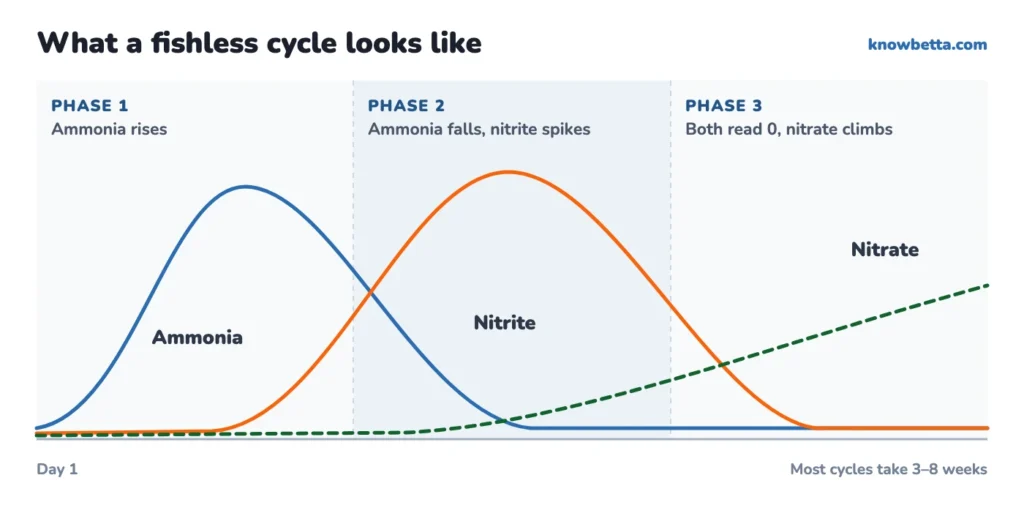
This is the part that takes patience. Test your water every day for ammonia, nitrite, and nitrate.⁵ You’ll see a pattern unfold:
- First, ammonia rises.
- Then ammonia starts to drop and nitrite spikes.
- Then nitrite drops and nitrate starts climbing.
You’ll also want to watch your pH. As the bacteria do their job, they use up some of the minerals in your water that keep pH steady, so pH can drop over time.⁵ If it goes below 7.0, a small water change usually brings it back up. Bacteria grow best when pH is between 7.0 and 8.0.⁴
5. Confirm the cycle is complete.
Your tank is cycled when you can add ammonia up to 2–3 ppm and it drops back to 0 within 24 hours, with nitrite also at 0.⁵ You should see some nitrate in the water too, which means the whole process is working.
The final step is to do a big water change to lower the nitrate before you add your betta.
How Long Does It Take?
Most fishless cycles take about six to eight weeks.² If you add bacteria from another tank, it can go faster. Warmer water and steady pH also help the bacteria grow more quickly.⁴
If it’s been more than eight weeks and you still see ammonia or nitrite, check your pH and make sure you’re still adding ammonia. Sometimes the cycle stalls if something in the tank changes.
What About Fish-In Cycling?
Let’s be real for a second: most people already have their betta in the tank before they even hear the word “cycling.” If that’s you, don’t worry. You can still get through this safely with a bit of extra effort.
Fish-in cycling means your betta’s waste is what feeds the bacteria as they grow. The tricky part is your betta has to live through the spikes in ammonia and nitrite. Your job is to keep those numbers as low as you can until the bacteria catch up.⁵
Here’s how:
- Test daily. You need to know exactly where your ammonia and nitrite levels are. Don’t skip this step.
- Do water changes often. Start with 20% each week, but if your tests show ammonia or nitrite going up, change 25% to 50% right away.⁵ If the numbers stay high, you might need to do daily water changes until things settle down.
- Use a water conditioner that can bind ammonia. Products like AmQuel or Ammo-Lock can turn toxic ammonia into a less harmful form for a while.² This isn’t a permanent fix, but it gives your betta a break while the bacteria get established.
- Consider adding a bacterial starter. A commercial culture or some filter media from a cycled tank can make this whole process go faster.⁵
- Don’t add any more fish right now. Your biological filter is already working hard to keep up with one betta. Adding more would just make things tougher.³
The fish-in cycle still takes roughly the same amount of time as the fishless cycle. You’re just managing the water quality manually the whole way through.
How to Know When Your Tank Is Cycled
The numbers you’re looking for are simple:
- Ammonia: 0 ppm. Any detectable ammonia means the cycle isn’t complete or something has disrupted it.
- Nitrite: 0 ppm. Same story. Nitrite should be undetectable in a fully cycled tank.
- Nitrate: Some. You want to see some nitrate (that means the cycle is working), but keep it under 50 ppm for your betta’s long-term health.
If you’re fishless cycling, the gold standard is dosing ammonia to 2–3 ppm and seeing both ammonia and nitrite return to 0 within 24 hours.⁵
If you’re doing a fish-in cycle, you want to see 0 ammonia and 0 nitrite for several days in a row, without water changes being the reason. Make sure to follow your test kit’s instructions and check your results in good light against a white background.
Keeping Your Cycle Stable Long-Term
Once your tank is cycled, your job is to keep it stable. The bacteria in your filter are living organisms, and they need the right conditions to stay healthy.
Do regular water changes
Partial water changes (usually 20% to 30% each week for a betta tank) do two things: they get rid of built-up nitrate and put back minerals that keep your water chemistry steady.² If you skip water changes for too long, your tank can lose its buffering minerals, and pH can drop fast. This is called “old tank syndrome,” and it can be just as risky as new tank syndrome.²
Always treat your replacement water with a dechlorinating conditioner before adding it to the tank. Chlorine and chloramine in tap water will kill your beneficial bacteria on contact.⁴
Don’t replace your filter media unnecessarily
This is a really common mistake. Most of your helpful bacteria live in your filter sponge or biomedia.¹ If you throw it out and put in a new one, you’re basically crashing your own cycle.
Instead of replacing filter media, gently rinse it in old tank water to get rid of gunk. Never rinse it under the tap. If your filter has more than one type of media, only change one at a time so you don’t lose all your bacteria at once.³
Be careful with medications
Some aquarium medications, especially antibiotics, can kill the good bacteria along with the germs you’re trying to treat. If you have to medicate your betta, keep a close eye on your water parameters during and after treatment. You might need to add more bacteria or do extra water changes if your cycle gets knocked back.
Don’t overload the system
A sudden increase in waste, whether from overfeeding or adding too many tank mates at once, can produce more ammonia than your bacteria can handle.³ Add new tank mates slowly, and only feed what your betta can finish in a couple of minutes.
Read More: Betta Fish Tank Mates: Best Fish, What to Avoid, and Compatibility Tips
Keep the filter running
It might sound obvious, but it matters because your bacteria need oxygen from moving water to survive.² If the power goes out, the filter gets clogged, or you turn it off overnight, the bacteria can start to die off. If your filter ever has to be off, get it running again as soon as you can.
Quick Reference: Target Water Parameters for Bettas
| Parameter | Target | Danger Zone |
|---|---|---|
| Ammonia | 0 ppm | Any detectable amount |
| Nitrite | 0 ppm | Above 0.2 ppm |
| Nitrate | Below 50 ppm | Above 50 ppm long-term |
| pH | 6.5–7.5 | Sudden shifts in either direction |
| Temperature | 77°F–82°F | Below 74°F or above 86°F |
The Bottom Line
Cycling your tank is the single most impactful thing you can do for your betta’s health. It’s not glamorous. It requires patience and a test kit. But once that colony of bacteria is established and doing its job, you’ve built the foundation for a tank that practically takes care of itself.
And if you’re reading this after already adding your fish, that’s okay. You’re here, you’re learning, and you can absolutely manage a fish-in cycle with testing and water changes. The fact that you’re looking this up at all means you’re already a better betta keeper than you think.