What Size Tank Do Bettas Need?
If you’re setting up your first betta tank (or rethinking the one you’ve got), tank size is one of the most important decisions you’ll make. It affects everything from how often you’re cleaning to how active and healthy your fish will be.
Let’s cut straight to it.
The Short Answer
We recommend a 5-gallon (19-liter) tank as the minimum for a single betta.
That’s not an arbitrary number. A 2024 study on betta behavior found that males need at least 10 liters (about 2.6 gallons) of enriched space just to express their natural swimming behaviors.1 Below that threshold, their movement is physically suppressed by the space itself.
Five gallons gives your betta comfortable room above that research minimum. It also gives you a tank that’s manageable to heat, filter, and maintain without constant upkeep.
Why Size Matters When It Comes to Fish Tanks
It’s easy to think of tank size as just a space question. But the volume of water in your tank directly affects water quality, temperature stability, and your betta’s behavior. Here’s how.
Water Quality and Stability
In a small container, ammonia from your betta’s waste builds up fast.4 The less water you have, the quicker those toxins concentrate, and the more often you’ll need to do water changes to keep your fish safe. In very small, unfiltered setups, that can mean changes every couple of days.3
A larger volume of water dilutes waste more effectively and stays stable longer.9 That means fewer dramatic swings in your water parameters and a more forgiving environment when life gets busy and you miss a day.
It’s also worth knowing that anything you put in the tank (gravel, decorations, a filter) displaces water and reduces the actual volume your fish is living in.8 In a 1-gallon bowl, a handful of gravel and a plant can eat up a surprising amount of that already-tiny water volume. In a 5-gallon tank, those same items barely make a dent.
Temperature
Bettas are tropical fish. They need warm, stable water, and tank size plays a direct role in how achievable that is.
Water holds heat well, but only when there’s enough of it.10 A larger body of water resists temperature changes, acting as a thermal buffer against drafts, room temperature shifts, and direct sunlight. Small tanks don’t have that buffer. They heat up and cool down quickly, and those rapid swings stress your betta’s immune system and leave them vulnerable to illness.9
There’s a practical safety concern here, too. If a heater’s thermostat malfunctions and gets stuck in the “on” position, it can overheat a small tank dangerously fast. One useful tip: if you’re heating a smaller tank, consider using a slightly undersized heater (less than the standard 5 watts per gallon). It’ll still keep the water warm enough, but if the thermostat fails, it won’t be powerful enough to cook the tank.7
Swimming Space and Enrichment
This is where a lot of people are surprised. Bettas aren’t the lazy, sedentary fish that tiny cups and bowls make them look like. In adequate space, they’re active, curious swimmers.
Research backs this up clearly. In small containers (0.5 to 1.5 liters, or about 1 to 3 pints), bettas spend significantly less time swimming and much more time resting or completely inactive.1, 2 Researchers interpret this inactivity as a sign of boredom or negative emotional state.2
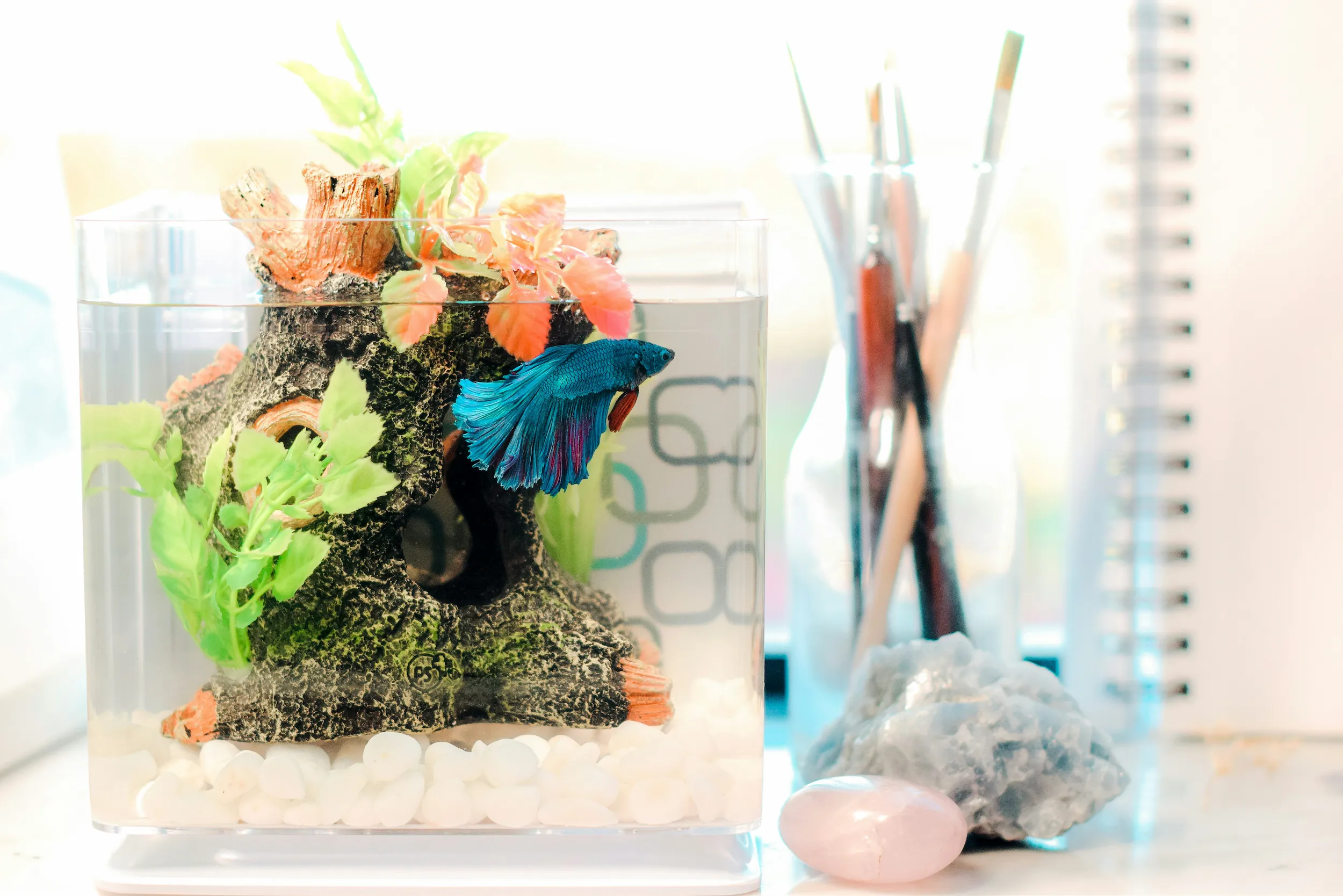
It gets more specific than that. In extremely small spaces, like 1.5-liter jars, bettas frequently “hover,” hanging motionless while only moving their pectoral fins.2 In slightly larger but still cramped tanks (around 3.3 liters, or a little less than 1 gallon), they’re more likely to pace or circle repetitively, a stress behavior called stereotypic swimming.2 Both are signs the fish is struggling with confinement.
In properly sized tanks, these abnormal behaviors largely disappear.2 Bettas swim throughout the water column, forage, and explore. Natural, positive behaviors like foraging show up much more frequently in larger setups.
What About Those Tiny Betta Tanks?
You’ve probably heard the claim that bettas live in puddles in the wild, so a small bowl is fine. It’s one of the most persistent myths in the hobby, and it’s worth unpacking.
Here’s what’s true: wild bettas do live in shallow water. The average depth of their natural habitat is only about 5 centimeters, or roughly 2 inches.6 That part is accurate.
But “shallow” doesn’t mean “small.” Wild bettas inhabit expansive, interconnected ecosystems: rice paddies, swamps, flooded plains, and canals across Southeast Asia.3, 6 These habitats are dense with aquatic vegetation, which provides cover from predators, supports the insects bettas feed on, and acts as a visual barrier between territorial males.3, 4
During monsoon season, heavy rains flood nearby fields, creating vast new stretches of warm, shallow water that bettas actively migrate into to breed.3 This is nothing like a cup or a bowl. It’s a complex, living environment that just happens to be shallow.
The reason bettas can survive in tiny containers is their labyrinth organ, which lets them breathe air from the surface.6 That adaptation evolved for oxygen-poor rice paddies, not for life in a jar. Surviving and thriving are very different things.
If you currently have your betta in a small setup, don’t beat yourself up. Misinformation about betta care is everywhere, and plenty of well-meaning pet stores still sell setups that are way too small. The good news is that upgrading is one of the single best things you can do for your fish, and a 5-gallon tank is affordable and easy to find.
Can You Go Bigger?
Absolutely. If you have the space and budget, your betta will use it.
One 2024 behavioral study found that bettas actively use all available space even in tanks as large as 208 liters (about 55 gallons). Swimming rates were similar across 10-liter, 38-liter, and 208-liter setups, which means your fish won’t be “overwhelmed” by a bigger tank.1 That’s a myth, too.
Bigger tanks are also easier to maintain. The water stays more stable, parameters are more forgiving, and you have more room for plants and enrichment.9 For a single betta, upgrading to a 10-gallon is a sweet spot that gives plenty of space without being complicated for a beginner.
Quick Recap
- 5 gallons is the minimum we recommend for a single betta. Research supports at least 2.6 gallons for natural behavior, and 5 gives you a comfortable margin.
- Bigger is better. Larger tanks are more stable, easier to maintain, and give your betta room to actually be a fish.
- Wild bettas don’t live in puddles. They live in shallow but expansive, plant-dense ecosystems. Small containers are survival, not suitable habitat.
- If you’re upgrading from a small tank, that’s great. It’s one of the most impactful changes you can make for your betta’s health and quality of life.