 Annie
Annie
Key Takeaways
- A betta can live without a filter, but not without the work it does. Bettas release ammonia into the water constantly. Either the filter’s bacteria break it down, or you manage it with an intense water-change schedule.
- If you skip the filter, I’d plan on several partial water changes every week. Skip a week and ammonia keeps climbing where you can’t see it. That’s why almost every experienced keeper recommends using a filter.
- Bettas do best with gentle filters. A sponge filter or a small filter with the flow turned down both work well. Bettas prefer calm water, and too strong of a current can actually stress them out.
- Bettas are tough in the short term, not the long term. They can survive short ammonia spikes that would kill most fish. Nobody has tested what months of low-level ammonia does to a betta, but in fish generally it damages the gills and weakens the immune system.
The filter question is usually the first equipment choice you’ll face, and the advice online is all over the place.
Here’s the short version: use a filter. Your betta won’t drop dead overnight without one, but fish constantly release waste into their water, and that waste has to go somewhere. There are only two ways to handle it: either a colony of bacteria living in a filter does the job for you, or you do it yourself with a bucket, several times a week, every week, for as long as you have the tank.
Doing it all yourself can work, but there’s no room for error. Life gets busy, or you might get sick or distracted. A filter gives you some breathing room. It turns a routine you can’t ever skip into one that lets you recover from a missed week. That’s the main reason most people recommend using a filter.
| Filtered Tank | Unfiltered Tank | |
|---|---|---|
| Who removes the ammonia | Bacteria in the filter, around the clock | You, at every water change |
| Water changes | One partial change a week | Two or three a week, every week |
| How often to test | Once a week | Twice a week |
| Water chemistry | Drifts slowly between changes | Swings with each big change |
| Going away for a few days | Usually fine | You’ll need someone to do the changes |
| What usually goes wrong | Flow too strong for the betta | Ammonia creeping up between changes |
What a Filter Actually Does
Every aquarium filter, no matter the brand, has two main jobs.
- First, it catches floating bits of debris. That’s called mechanical filtration.
- Second, it gives helpful bacteria a place to live. These bacteria take care of ammonia and nitrite, which are both toxic wastes from your fish, and turn them into something less harmful called nitrate. This is biological filtration.
Some filters have a third stage called chemical filtration. This usually just means a pouch of activated carbon, which is optional.
The filter needs to run all the time to keep its bacteria alive.¹ The biological stage is the one your fish relies on to stay healthy.
A lot of beginners get confused about where these bacteria actually live. Most of them aren’t floating in the water, and the filter doesn’t make them appear. Nitrifying bacteria grow on any wet surface in your tank: the glass, the gravel, even inside the pipes.² The filter media just gives them more space to settle, because it’s made with lots of surface area and has water moving past it all the time. The more space the bacteria have, the more ammonia they can handle. You can think of a filter as an apartment building for bacteria, instead of having them scattered in tents all over your tank.
These bacteria work together in a chain.
- Fish waste turns into ammonia.
- One type of bacteria changes ammonia into nitrite, which is still very toxic.
- Another type changes nitrite into nitrate, which is much less harmful and just builds up in the water until you remove it.³
This whole process is called the nitrogen cycle. In a new tank, it usually takes about six to eight weeks for enough bacteria to grow and get the cycle going.⁴ A brand-new filter is like a building with empty apartments. It won’t keep the water safe until the bacteria move in, and that takes time.
Read More: How to Cycle Your Betta Tank
What Happens in a Tank With No Filter
Your betta is always adding ammonia to its water. That’s just how fish work. Most of their nitrogen waste leaves their body through their gills as ammonia, whether you feed them or not.⁵
Even if you don’t have a filter, some nitrifying bacteria will still grow on the glass and gravel, so the nitrogen cycle still happens. But it’s much weaker and can’t handle as much waste as a filter with proper media.
We don’t have to guess what the chemistry does next, because somebody measured it. A 2026 study set up small, brand-new betta tanks with no filter to see whether live plants could help keep the water stable. Waste was siphoned out after every feeding and the water topped up daily, and ammonia still rose in every group over 25 days, planted and bare alike.⁶ It rose more slowly in the planted tanks.
How fast ammonia builds up depends on how much water you have. In smaller tanks, waste piles up faster and oxygen drops faster.⁷ A 5-gallon tank gives you more room for mistakes than a 1-gallon bowl, but it doesn’t mean you can skip the basics.
You can’t see any of this happening. Ammonia is invisible, so the only way to know it’s there is to test the water. Clear water just means there isn’t any debris floating around. It doesn’t mean it’s safe. Many unfiltered tanks look fine until the fish gets sick.
Why People Say Bettas Don’t Need Filters
“Bettas are basically indestructible”
Bettas are tougher than almost any fish you could put in that tank. That’s the problem.
One possible reason bettas are so tough is their labyrinth organ. This special organ lets them breathe air from the surface, not just through their gills. When water quality is bad, a betta may lean on air breathing for a while, so less dirty water passes over its gills.⁵
In 2023, researchers tested how much ammonia and nitrite adult bettas could survive for a few days. Ammonia in your tank comes in two forms: un-ionized ammonia, which is the toxic one, and ammonium, which is far less harmful.
Counting only the toxic form, it took 7.7 mg/L to kill half the bettas in four days. For most freshwater fish, that figure falls between 0.068 and 2.0 mg/L.⁵ So it took roughly four to over a hundred times more ammonia to kill a betta. Don’t hold your test kit up against that number, though: a kit measures both forms together.
But two things to note here:
- That study only ran for four days.
- It tells you how much ammonia kills a betta. It doesn’t tell you how much a betta can live with and stay healthy.⁵
Long-term, even low levels of ammonia wear fish down. That comes from research on fish in general, since nobody has measured what months of low-level ammonia do to a betta, and a betta welfare review warns against borrowing other species’ numbers.⁷ In fish generally, it doesn’t kill them right away. Instead, it slowly damages the gill tissue that fish breathe through.⁸ It also keeps fish stressed, which makes them more likely to get sick, even at levels that aren’t deadly.³ And fish can get sick weeks after ammonia levels in the water are fixed.⁴
So bettas are tough in the short term, not the long run. If your tank doesn’t have a filter and you miss some water changes, your fish probably won’t die right away. If bettas react like other fish, the damage builds up slowly instead. When a betta seems to get fin rot out of nowhere after a year or more, it has often been having a hard time for a while before you noticed.
TL;DR: A betta’s hardiness just gives you a bigger window to catch and fix problems with their tank’s water quality. It doesn’t mean the water quality doesn’t matter.
“Bettas live in puddles in the wild”
The habitat part is half true. Wild bettas in Thailand have been documented nesting in warm water about 5 centimeters deep, which is roughly 2 inches.⁹ Water sampled nearby was acidic and low in oxygen, and these are slow, quiet spots.⁹ So yes, it’s shallow and still.
But think about where that shallow water actually is. The same field study found bettas living among thick plants along the edges of rice paddies.⁹ Other research talks about flooded fields and marshes packed with plants.¹⁰, ¹¹ All of that is a living system, where plants and bacteria are presumably breaking down waste across far more water than the little spot one fish uses.
A rice paddy has mud and tons of plants.⁹ Your tank is a closed box: nothing leaves unless you take it out yourself.
A betta welfare review notes that the labyrinth organ is what created the belief that bettas don’t need a large volume of water, and points out the flaw: the smaller the volume, the faster waste accumulates, so the water has to be filtered or changed regularly.⁷ Even the hobbyist book that says you can skip a filter puts it flatly: an aquarium, unlike a river or lake, is a closed system, and toxins will build up in it no matter what clever ideas you come up with.¹²
Waste isn’t the only thing that piles up in a small tank. If you only use water changes to keep things clean, the pH (how acidic or basic the water is) and hardness (how many minerals are in the water) can shift suddenly with each change, especially when the new water doesn’t match the old.¹ That’s why the same manual recommends some kind of filter for most tanks.¹
One more thing about that 5 cm: it’s where the males were building their nests. The researchers note that wild bettas move out of streams and ponds into these shallows to breed,⁹ so it’s breeding habitat, not proof that bettas spend their lives in two inches of water.
“Breeders, labs, and pet stores don’t use filters”
They often don’t. A 2024 welfare study even left filters out of most of its experimental tanks “since typically Siamese fighting fish are not housed with filters.”¹³ Commercial farms grow males to selling size in individual bottles.¹⁴
The mistake is thinking any of that means it’s good for the fish. Farms and labs set things up to keep fish from fighting, to fit a lot of fish into a small space, and to keep costs down.¹⁴, ¹⁵, ¹⁶ They also rely on management and equipment that you won’t have at home.
The clearest example comes from a published lab care guide. Its adult research bettas each live in a 0.8- or 1.4-liter tank, about one to one and a half quarts. But those tanks all plug into one shared water system: the water leaves each tank, runs through four filter stages, and comes back clean. About 15% of the whole system’s water gets swapped out every day, and the system gets tested weekly, with ammonia held at undetectable levels.¹⁵
So the real question isn’t just yes or no. It’s about who’s doing the work to keep the water safe.
Choosing and Maintaining The Right Filter for a Betta Tank
You’ll find a list of betta-friendly filters here, but let’s go over how to pick one and keep it working for your betta.
Go for gentle flow, not strong current
Most betta tanks work with one of two filter setups:
- A sponge filter. This setup uses an air pump to push bubbles up a tube. As the bubbles rise, they pull water through a sponge. The sponge catches debris (mechanical filtration) and gives helpful bacteria a place to live (biological filtration). The flow is gentle enough that most bettas barely notice it. Sponge filters are cheap, quiet, and simple.
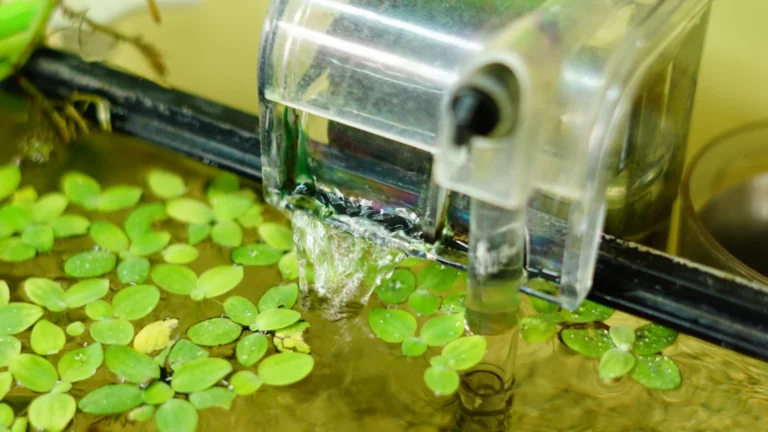
- A small hang-on-back filter or an internal filter with a flow dial, set to the lowest setting. If your betta still gets pushed around by the current, you can slow it down even more by blocking part of the outflow. You can do this with things you already have, like a piece of sponge or a plastic bottle.
Keep your filter alive with gentle cleaning
The helpful bacteria you grew during cycling can die quickly if you clean too much or use tap water. Always rinse filter media gently in a bucket of tank water, not under the tap.¹⁷ Chlorine and chloramine in tap water kill these bacteria. The slippery film on your filter media is where most of them live, so don’t scrub it off. Cleaning every two to three weeks works for most tanks. If your filter uses cartridges, only change one at a time so you don’t lose all your bacteria at once.
Water changes are still part of the routine
A filter turns fish waste into something less harmful, but it doesn’t get rid of it completely. The last step is nitrate, which builds up in the water until you remove it with a water change. The filter means you shouldn’t have to worry about ammonia and nitrite, but you still need to do regular water changes to keep your betta healthy.
Read More: Betta Tank Cleaning and Water Changes
Already Running Without One? Here’s Your Routine
I still don’t recommend going without a filter, but if you’re set on it (or just waiting for your filter to arrive), you’ll need to rely on frequent water changes to keep ammonia and other waste from building up to dangerous levels. When fish hospitals can’t give a tank an established biofilter, they keep stays short, test the water every day, and let water changes do most of the work, backed by mechanical and chemical filtration.¹⁸
Here’s the routine I’d follow:
- Pick up a test kit before you do anything else. If you ever see ammonia or nitrite (which is another toxic waste product) above zero, it means your water change routine isn’t keeping up. Testing twice a week is a good starting point.
- Stick with a real tank, not a bowl. The more water you have, the slower ammonia builds up. Five gallons is about the smallest tank I’d try this in. Anything smaller gets overwhelming fast.
- Start with two or three partial water changes a week, swapping out about a third of the water each time. This works best if you aren’t overfeeding. Adjust how often you change water based on your test kit results, not just by the calendar.
- Keep your water changes as routine as possible. Always use the same dechlorinated water, matched to your tank’s temperature, and try to stick to a regular schedule. One way filterless tanks go wrong is when water chemistry swings wildly after a big change, so it’s better to do lots of small, gentle changes instead of the occasional huge one.
- Add lots of live plants if you can, but don’t treat them as a replacement for a filter. Plants can help slow down how quickly ammonia builds up, but you’ll probably still see ammonia rise over time.⁶ Think of plants as a brake, not a full stop.
What To Do When You’re Ready To Add the Filter
The switch is easy, and there’s no drama for the fish. Your tank walls and gravel already hold some of the bacteria.² Still, new filter media starts empty, so run the filter and keep your water-change routine going for the six to eight weeks new media needs,⁴ then stretch out the gaps between changes one step at a time, testing ammonia and nitrite before each step. If you know someone with a healthy, established tank, borrow their head start: a veterinary manual suggests running a new sponge filter in an established, disease-free tank first, which helps a new setup avoid the usual early water problems.¹⁹
The real problem with running a tank without a filter isn’t not knowing what to do. It’s what happens when life gets busy, whether through travel, getting sick, or just having a week where you’re too tired to keep up. A filter is what helps your betta’s tank get through those times when you can’t be perfect.
The One Test That Actually Answers the Filter Question
If you want to know if your tank setup is working, check your ammonia level. Ammonia is a waste product that should always read zero on your test kit. If you see any ammonia at all, it means your tank (whether it has a filter or not) is not handling waste fast enough. In that case, you’ll need to make some changes.⁴ For most filtered tanks, testing once a week is enough. If you don’t use a filter, you’ll want to test more often, and it’s a good idea to check any time your betta seems unwell.
If you keep seeing ammonia on a schedule you can realistically keep up with, that’s your tank’s way of saying it needs less food, a filter, or bigger water changes, not that you’re doing something wrong. Your betta can show water trouble directly too. Hard or uneven breathing is a common sign of ammonia in fish,⁸ and poor water is a common trigger for fin rot.¹ Fix the water first, whatever else you do.
Read More: Fin Rot in Betta Fish